

Amyotrophic Lateral Sclerosis (ALS) Model
Sichuan Greentech Bioscience provides a range of animal models for neurodegenerative diseases, including Parkinson’s disease (PD), Alzheimer’s disease (AD), and amyotrophic lateral sclerosis (ALS), to support preclinical efficacy evaluation of therapeutic candidates for common neurodegenerative disorders.
Our ALS Model: hSOD1-G93A Transgenic Mouse Model
Transgenic mouse models carrying disease-associated mutations play an important role in ALS research. Although familial ALS involves multiple genetic mechanisms, these transgenic models exhibit similar ALS-related phenotypes (Figure 1). SOD1 was the first gene identified as being associated with fALS. The hSOD1-G93A transgenic mouse is one of the most widely used ALS animal models and exhibits motor neuron loss, paralysis, and premature death. The FDA-approved ALS therapies riluzole and edaravone have both been evaluated using the hSOD1-G93A mouse model.
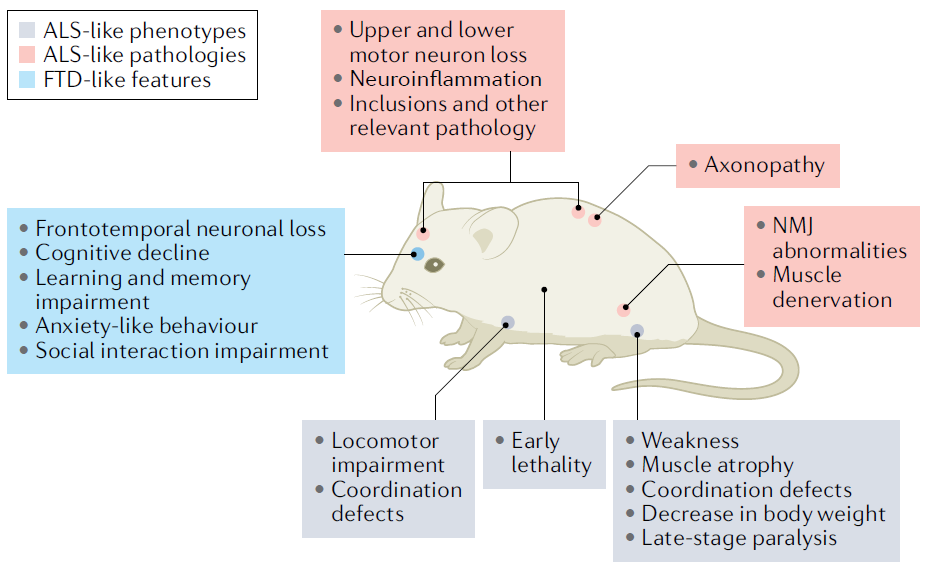
Figure 1. ALS-like pathology (red) and ALS-like phenotypes (gray) in ALS mouse models. Some models also exhibit frontotemporal dementia (FTD)-like features (blue) (Todd & Petrucelli, 2022). Although ALS and FTD affect different neurons, clinical observations indicate that they frequently occur in the same patient.
Representative Case Studies
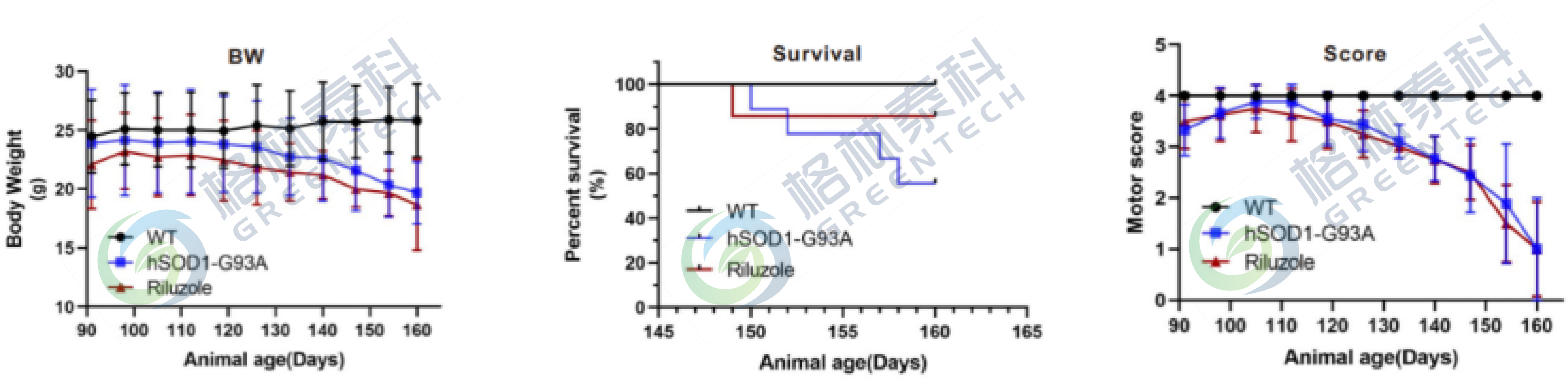
Figure 2. Body weight, survival, and neurological function scores in ALS mice (hSOD1-G93A mice).

Figure 3. Neurological function scores in ALS mice (hSOD1-G93A transgenic mice).

Figure 4. Gastrocnemius muscle atrophy in ALS mice (hSOD1-G93A transgenic mice).
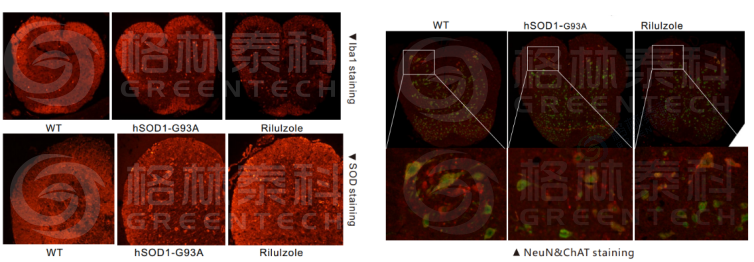
Figure 5. NeuN and ChAT co-staining in the anterior horn of the spinal cord in hSOD1-G93A mice.
References
1.Todd TW, Petrucelli L. Modelling amyotrophic lateral sclerosis in rodents.[J].Nat Rev Neurosci,2022,4:231-251.
Inquiries
Request a quote now, or email us at BD@greentech-bio.com to inquire about our services or obtain a quote for your project.
-
- CRO Services
- Cardiovascular Diseases
- Psychiatry & Neurology
- Oncology
- Metabolic Diseases
- Inflammation & Autoimmune Diseases
- Pain & Analgesia
- Bone, Joint & Cartilage Diseases
- DMPK & Non-GLP Toxicology
- In Vitro Drug Screening
- Efficacy Testing for Medical Devices
-
- Platforms
- Endovascular Surgery
- Behavioral Tests
- Histopathology
- Clinical Testing
- Bioanalysis
-
- Resources
- Brochure
- FAQ
-
- About Us
- Company Profile
- Company Culture
- Honors
- Cooperators
- Enterprise Memorabilia
-
- News & Blog
- Company News
- Blog
-
- Contact Us